By Jason Kohlmeyer, Family Law Attorney
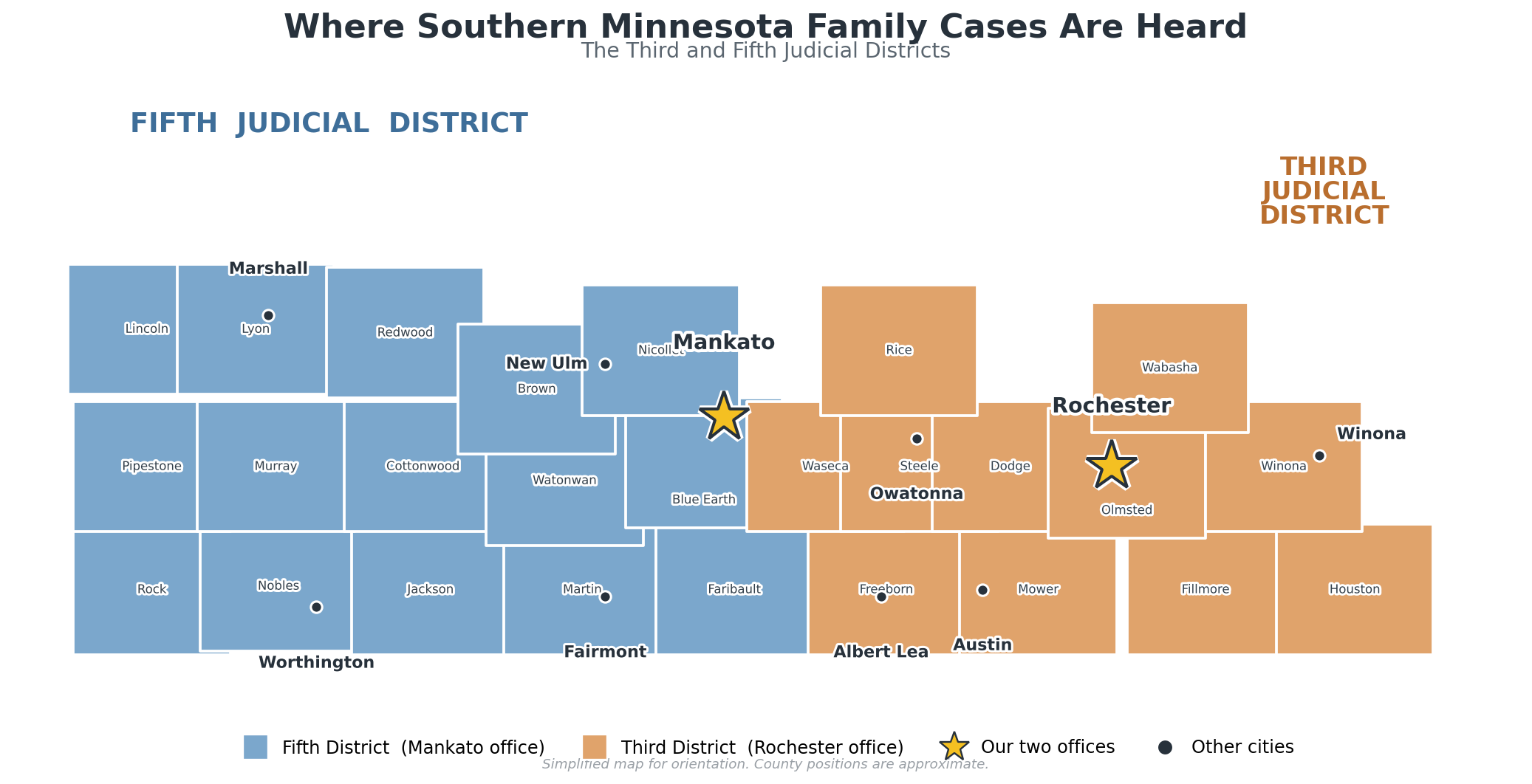
In Minnesota, your divorce or family case is filed in the district court for the county where you or your children live. Each of Minnesota’s 87 counties falls within one of 10 judicial districts. In southern Minnesota, that almost always means one of two. The Fifth Judicial District covers fifteen counties in the southwest and is administered from Mankato. The Third Judicial District covers eleven counties in the southeast and is administered from Rochester.
A judicial district is just a group of counties that share court administration and a pool of judges. Minnesota has ten of them. The split exists for staffing and management, not because the law changes from one district to the next (although the Judges can certainly interpret the law differently from county to county!).
Your case is still heard in the county where it belongs. If you live in Blue Earth County, your hearings happen at the courthouse in Mankato, not at some central district office. The district is the bigger umbrella over that courthouse.
The ten districts are set by statute. Minnesota Statutes section 2.722 lists each district and the counties within it. That same statute tells you where the district’s judges keep permanent chambers, which matters more than most people expect. I’ll circle back on this in a few minutes.
Draw a rough line down the middle of the southern third of the state. The southwest is the Fifth District. The southeast is the Third District. The map above shows the split. Here is what each one covers.
The Fifth covers fifteen counties: Blue Earth, Brown, Cottonwood, Faribault, Jackson, Lincoln, Lyon, Martin, Murray, Nicollet, Nobles, Pipestone, Redwood, Rock, and Watonwan. Its largest community is Mankato, in Blue Earth County, where the district administration sits.
NOTE: Every County seat in Minnesota* has it’s own courthouse, so first thing to find is the judicial district, then the county and the county seat will have the courthouse (usually….the Metro area and Duluth are different)
This is wide, rural country. Marshall, New Ulm, Worthington, Fairmont, and Windom are the other regional hubs and the county seats of those counties. Much of my farm and business divorce work runs through these counties, where the marital estate is often land, livestock, or a family operation rather than a paycheck.
The Third covers eleven counties: Dodge, Fillmore, Freeborn, Houston, Mower, Olmsted, Rice, Steele, Wabasha, Waseca, and Winona. Its anchor is Rochester, in Olmsted County, home to the district administration and the largest court in the region.
The Third runs from Albert Lea and Austin near the Iowa line up through Owatonna and Faribault. From there it reaches east into the bluff country along the Mississippi at Winona and Houston. Rochester handles a large share of cases because of its size and the Mayo and IBM workforce.
Two questions decide it. First, can you file in Minnesota at all. Second, which county is the right one?
First, Minnesota Statutes section 518.07 sets the residency rule. At least one spouse must have lived in the state for at least 180 days before the case starts. Active-duty military stationed here for 180 days also qualifies. Your spouse does not need to live in Minnesota if you meet the rule.
Ssecond, the venue is governed by Minnesota Statutes section 518.09. A divorce is brought in the county where either spouse resides. When children are involved, the court cares about where the children actually live. So a Rochester parent files in Olmsted County, and a Marshall parent files in Lyon County, even though both sit in southern Minnesota.
Minnesota has organized its trial courts into districts since territorial days. As the state grew, the number and shape of the districts changed many times to keep up with population and caseloads.
The system you see today took its modern form in 1959, when the Legislature reorganized the trial courts into ten administrative judicial districts. The boundaries have been adjusted since, but the ten-district structure has held for more than sixty years. The current lines and county lists live in section 2.722.
Here is the practical part, and it is the reason the district is more than a label.
Section 2.722 lists where each district’s judges keep permanent chambers. In the Fifth District, those chambers sit in Mankato, New Ulm, Marshall, Windom, and Fairmont. Fifteen counties, five chambers towns. The judges ride the circuit among the remaining counties.
In practice, that means a divorce in a smaller Fifth District county can move on the calendar of a judge who is only in that courthouse on certain days. Scheduling a contested motion in a rural county is not the same as scheduling one in Mankato or Rochester, where more judges sit. In a high-conflict case, where you may be in front of the court repeatedly, that rhythm shapes how fast your matter moves. I plan around it from the first filing.
Olmsted County is a unique outlier in Southern MN, they have their own rules (some of which seem to conflict with MN Statutes). A few examples are the PJMC system that ONLY Olmsted uses, the judge will require you to go to mediation, every time you want to modify a divorce or custody decree. Several of the Judges will also require several mediation attempts before even setting a trial date. This matters because that’s $5-10K of extra expense just on those issues.
Contrast that with say Martin County, you have an issue regarding parenting time, and you file a motion, you get a date and argue it out, and the Judge makes a ruling. Much simpler, faster, and cheaper, and what I would argue is the better way to run a family law court, but that’s just my opinion.
That is common, and it is usually not a problem. If the two of you live in different Minnesota counties, either county can be a proper venue. Often the case lands where it is filed first.
It can matter more than people think. A case in Olmsted County may reach a hearing on a different timeline than the same case in a small neighboring county. If you are weighing where to file, that is worth a conversation before the petition goes out, not after.
If you want to check your own county, the Minnesota Judicial Branch keeps a district finder and a page for each district. You can confirm your courthouse, the district office, and current contact information there.
You can read the controlling rules yourself. Residency is in Minnesota Statutes section 518.07, venue is in section 518.09, and the districts and their counties are in section 2.722. The court’s own pages for the Fifth Judicial District and the Third Judicial District list every county courthouse. The district finder maps any county to its district in one step.
About the author: Jason Kohlmeyer is a Minnesota family law attorney with over 25 years years of experience and a partner at Kohlmeyer Hagen Law Office in Mankato and Rochester. He has practiced family law exclusively since 2010 and has handled hundreds of custody cases across southern Minnesota. He is the author of The Divorce Survival Guide: Getting Divorced in Minnesota and has spoken on family law topics for the American Bar Association, Minn. State Bar associations and American Trial Lawyers Association. He is a member of the Minnesota State Bar Association and has been recognized by Super Lawyers and Best Lawyers of America for many years.




