
By Jason Kohlmeyer, Family Law Attorney
The most common shared custody schedules in Minnesota are the 2-2-3, the 2-2-5-5, and the alternating week (week-on, week-off). Each one splits parenting time close to 50/50 over a two-week cycle.
NOTE: We typically talk about 2-week periods instead of monthly because of the odd number of days, but if we deal with 14 days, it’s pretty easy to understand!
They differ mainly in how often the children move between homes and how long each parent goes without seeing them. The 2-2-3 changes homes often and keeps both parents in the picture every few days, the 2-2-5-5 gives each parent the same fixed weekdays with rotating weekends, and week-on/week-off keeps exchanges to a minimum but means a full week apart. There is no single correct schedule. The right one depends on your children’s ages, how far apart the two homes are, and each parent’s work.
I have practiced family law in Minnesota for over 25 years, and parenting time schedules come up in almost every case I handle. Below, I walk through how these schedules actually work, what the law requires, and the practical questions I ask clients before we commit anything to a parenting plan.
Minnesota separates custody into two pieces. Legal custody is the authority to make major decisions about a child’s education, health care, and religious upbringing. Physical custody concerns where the child lives and the daily care routine. Many parents share both, but you can share legal custody while one parent has the majority of the physical custody time. When people say “shared custody,” they usually mean a roughly even division of physical custody time, which in practice is the parenting time schedule.
Custody and parenting time are decided under the best interests of the child standard in Minnesota Statutes section 518.17, which lists twelve factors a court weighs, including the child’s needs, each parent’s ability to care for the child, and the benefit of maintaining a relationship with both parents. One detail that surprises many parents is the floor the law sets on parenting time. Under Minnesota Statutes section 518.175, there is a rebuttable presumption that each parent receives at least 25 percent of the parenting time, usually measured by overnights. That presumption is the starting point in most cases, and a true 50/50 schedule is one common way parents land well above it.
When parents want an even split, three schedules cover the large majority of what I see. All of them run on a repeating two-week cycle, so the easiest way to understand them is to look at two weeks side by side.
In a 2-2-3, one parent has the children for two days, the other parent has them for the next two days, and then one parent takes a three-day weekend. The following week the pattern flips, so the parent who had the short start now gets the long weekend. Over the full two weeks, it comes out to an even split.
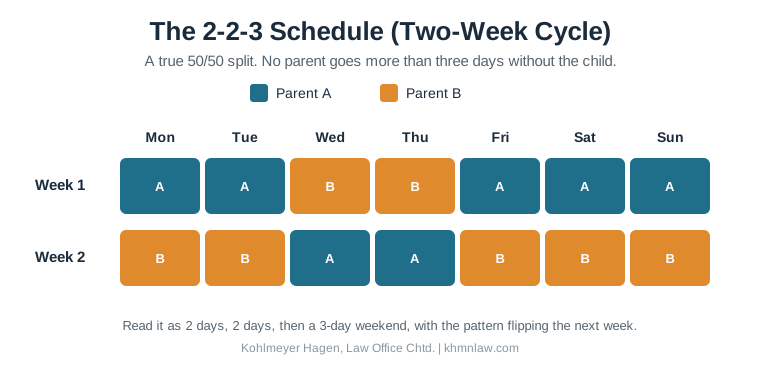
The benefit of the 2-2-3 is that no parent goes more than a few days without seeing the children. That frequent contact works well for younger children, who often do better when neither parent feels far away for long. The cost is the number of exchanges. You are handing off the children every two or three days, which means a lot of coordination and many opportunities for friction and conflict if the relationship between the parents is tense. In high-conflict cases, I sometimes steer families away from the 2-2-3 for exactly that reason, because every exchange is another opportunity for an argument in front of the kids.
The 2-2-5-5 also produces a 50/50 split, but it solves the consistency problem differently. One parent always has Monday and Tuesday. The other parent always has Wednesday and Thursday. The weekend, Friday through Sunday, alternates between them. Because the weekday assignments never change, each parent and child knows that Mondays and Tuesdays, or Wednesdays and Thursdays, are always the same. The trade-off is that each parent gets a five-day stretch every other week.
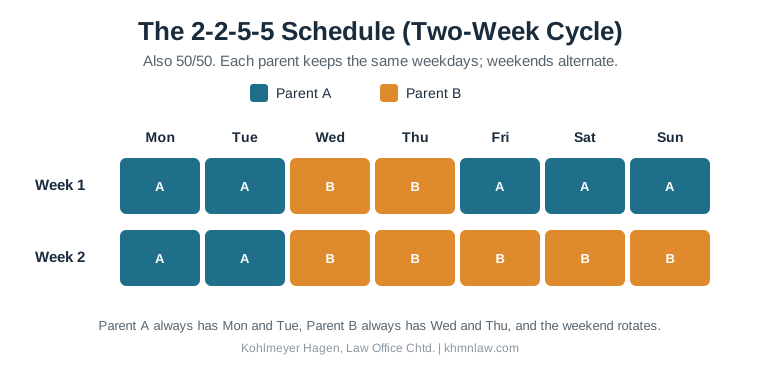
Parents tend to like the 2-2-5-5 once children are in school, because the fixed weekdays make it easy to plan activities, homework routines, and work schedules. There are fewer exchanges than a 2-2-3, and the predictable midweek days reduce the back-and-forth confusion that younger schedules can create. The five-day stretch can feel long for a toddler, so this schedule usually fits better as children get a little older.
Personally, I will say this is my favorite type of joint schedule. It is easy to understand, has fewer changes, and often works best for older kids.
The simplest 50/50 arrangement is the alternating week. The children spend one full week with one parent, then the next week with the other. Some families add a midweek dinner, or overnight, so neither parent goes a full seven days without contact. This schedule has the fewest exchanges of any option, which is why it appeals to parents who live farther apart or who simply want less week-to-week complication. The downside is the obvious one. A week is a long time for a young child to be away from a parent, so I rarely recommend a straight week-on, week-off for children under school age.
Often time this is the first pitched settlement option because it seems easy. I will say, back when I started in the early 2000’s, this was the default idea of 50-50 custody, but it is viewed a little differently in 2026.
Not every family fits an even division, and Minnesota law does not require one. When one parent travels for work, lives a long way from the children’s school, or simply has a schedule that cannot support equal time, a more traditional arrangement may make sense. A common version is every other weekend with one weeknight, where one parent has the majority of the overnights and the other has alternating weekends plus a midweek visit. Even in that situation, remember the 25 percent presumption under section 518.175. A schedule that gives one parent far less than a quarter of the parenting time needs a real reason behind it, not just one parent’s preference.
When I sit down with a client, the schedule conversation usually comes down to three practical questions. How old are the children, and how long can they comfortably go without seeing each parent? How far apart are the two homes, especially measured against the school and daily activities? And what do each parent’s work hours actually allow, not in theory but on a normal Tuesday? A schedule that looks fair on paper falls apart fast if it ignores a 5:30 a.m. shift or a 40-minute drive each way.
Distance deserves extra attention here in southern Minnesota, and this is where I see good schedules go wrong. A 2-2-3 depends on frequent, easy exchanges, which is fine when both parents live in Mankato or both live in Rochester. It becomes a real burden when one parent stays on the family farm outside Janesville or Waseca, and the other has moved into town for work, because every exchange turns into a 30 or 40-minute drive on top of school and activities. For families spread across the region, I more often recommend a 2-2-5-5 or an alternating week, which cuts the number of trips while still keeping the time even. The right schedule has to match the map you actually live on, not just the calendar.
You do not have to use a formal parenting plan, but I usually recommend one. Under Minnesota Statutes section 518.1705, a parenting plan must include a schedule of the time each parent spends with the child, a designation of decision-making responsibility, and a method for resolving disputes. A good plan does not stop there. It spells out how holidays and school breaks rotate, who handles transportation and where exchanges happen, what time pickups occur, and how the parents will communicate about changes. The schedule grids above describe the ordinary week, but most conflicts I see after a divorce are about the exceptions, the holidays, the snow days, and the missed flights. Writing those rules down before you need them is the single best thing you can do to keep yourself out of court later.
About the author: Jason Kohlmeyer is a Minnesota family law attorney with over 25 years years of experience and a partner at Kohlmeyer Hagen Law Office in Mankato and Rochester. He has practiced family law exclusively since 2010 and has handled hundreds of custody cases across southern Minnesota. He is the author of The Divorce Survival Guide: Getting Divorced in Minnesota and has spoken on family law topics for the American Bar Association, Minn. State Bar associations and American Trial Lawyers Association. He is a member of the Minnesota State Bar Association and has been recognized by Super Lawyers and Best Lawyers of America for many years.


