By Jason Kohlmeyer, Family Law Attorney
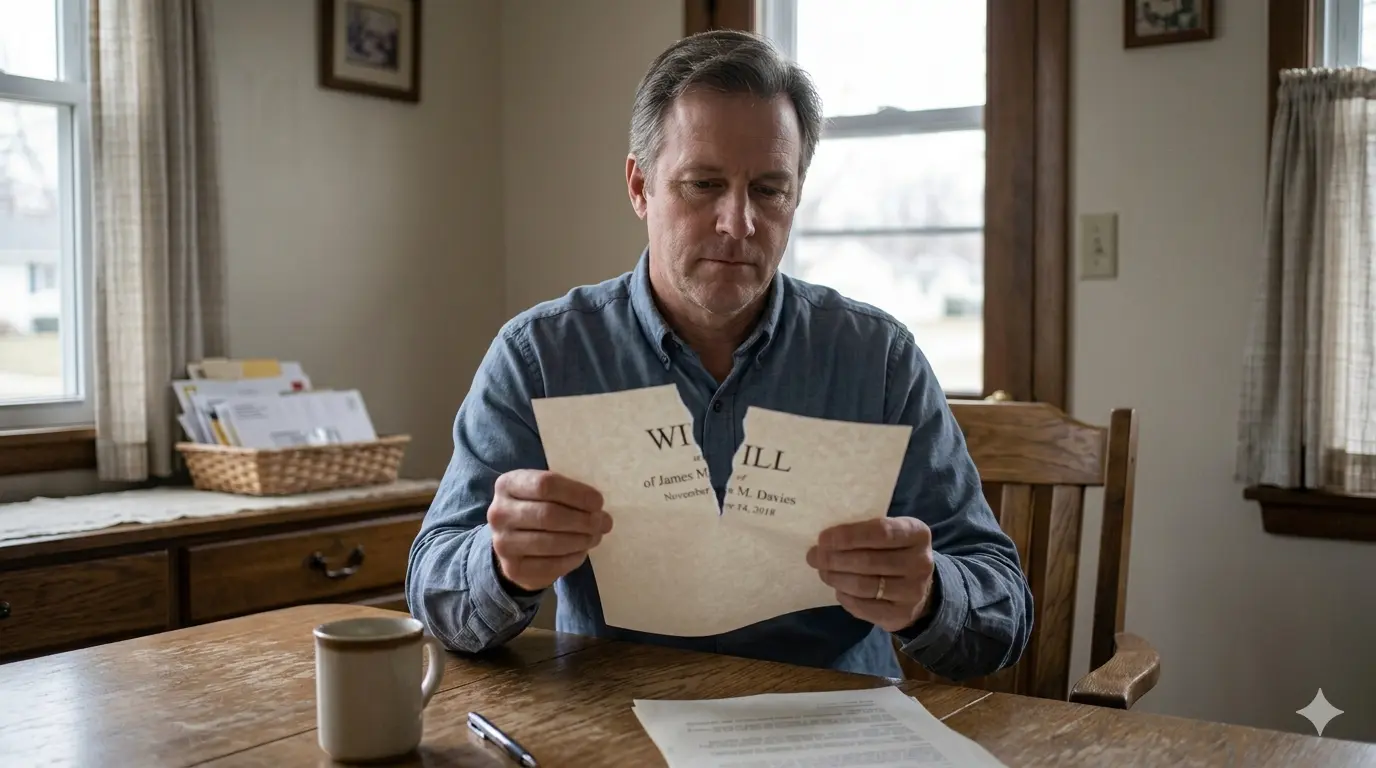
The short answer is that your will is void after you divorce. When your Minnesota divorce becomes final, state law automatically cancels most of the gifts and roles you gave your spouse in your will, your trust, your powers of attorney, and many beneficiary designations. Under Minnesota Statutes section 524.2-804, the law treats your former spouse as if they died right before the divorce. You do not have to sign anything for that to happen. But this automatic fix has real gaps, and the biggest one involves your 401(k) and employer life insurance. So you still need to review your documents after the divorce closes.
I have practiced Minnesota family law for over 25 years. I do not draft wills or trusts, so nothing here is a pitch for estate planning work. This is what I tell divorce clients so they understand what their decree does and does not touch.
The divorce revokes any part of your will that leaves property to your ex. It also cancels their appointment as your personal representative, the person who would have administered your estate.
The same rule applies to trusts, powers of attorney, and health care directives. If you named your spouse as your attorney-in-fact or health care agent, that nomination falls away when the marriage ends.
For many assets, yes. The revocation statute covers payable-on-death bank accounts, transfer-on-death deeds, and beneficiary designations on accounts governed by Minnesota law. The law calls these governing instruments, and divorce strips your ex out of them.
The catch is that the protection is not universal. It stops at the edge of federal law. That edge is where most people get burned, and I cover it next.
There is also a notice issue. A bank or insurer that pays your ex before it receives written notice of the divorce is not liable for that payment. So speed matters. Telling the institution in writing protects you.
This is the trap. Most employer retirement plans and employer-provided life insurance are governed by a federal law called ERISA. Federal law overrides the Minnesota revocation statute for those plans.
In Egelhoff v. Egelhoff, the United States Supreme Court held that ERISA preempts state divorce-revocation statutes. The plan must pay whoever is named on the form, even an ex-spouse, even after the divorce.
The facts in that case are a warning. A man divorced never changed his Boeing beneficiary form and died weeks later. His ex-wife kept the pension and life insurance. His children got nothing.
So your decree does not fix your 401(k), your pension, or your group life policy at work. Only a new beneficiary form filed with the plan administrator does that. I tell clients to handle those forms the week the divorce closes.
Yes. Minnesota’s automatic revocation statute took effect in 2002, but it applies retroactively to every marriage in the state. It does not matter when you were married.
This was tested at the highest level. In Sveen v. Melin, a Minnesota case, the Supreme Court upheld the retroactive reach of the statute in 2018 by an eight-to-one vote. The retroactive application stands.
The revocation only triggers when the dissolution is final. During the case, while you are still legally married, your spouse remains on everything you have not changed.
If you die mid-divorce, your spouse remains your beneficiary, agent, and heir. That gap can last many months in a contested matter.
You can change some things during the case on your own, like a will or a payable-on-death form. Be careful, though. Minnesota dissolution law restrains both spouses from transferring or cashing out certain assets once the case is filed. Changing a beneficiary on a marital asset can cross that line, so ask your divorce lawyer before you touch retirement or insurance designations mid-case.
No. This is where I see the most confusion. Your decree divides your marital property and debts. It does not rewrite your will or refile your beneficiary forms.
Here in southern Minnesota, your dissolution is decided in district court, Blue Earth County in Mankato or Olmsted County in Rochester. That family court file and your estate documents are completely separate systems. The judge who signs your decree never sees your will, and the county does not forward anything to your bank or your plan administrator. Updating those records is on you after the case ends.
Start with the federal blind spots. File new beneficiary forms on every 401(k), pension, IRA, and life insurance policy. Those do not fix themselves.
Then, put new estate documents in place. The revocation statute removes your ex, but it does not name who you want instead. If your ex was your only named agent or beneficiary, you may be left with gaps the law fills in ways you would not choose. A new will, power of attorney, and health care directive close those gaps.
I do not handle drafting, so I refer clients to an estate planning attorney for the new documents.
About the author: Jason Kohlmeyer is a Minnesota family law attorney with over 25 years of experience and a partner at Kohlmeyer Hagen Law Office in Mankato and Rochester. He has practiced family law exclusively since 2010 and has handled hundreds of Family Law cases across southern Minnesota. He is the author of The Divorce Survival Guide: Getting Divorced in Minnesota and has spoken on family law topics for the American Bar Association, Minn. State Bar associations and American Trial Lawyers Association. He is a member of the Minnesota State Bar Association and has been recognized by Super Lawyers and Best Lawyers of America for many years.




